Dubai and the UAE’s 100 Million Mangrove Goal: Why Grow Bags Matter for Mangrove Nursery Infrastructure
Dubai and the UAE’s 100 Million Mangrove Goal: Why Grow Bags Matter for Mangrove Nursery Infrastructure
The UAE is accelerating mangrove restoration and coastal greening as part of its broader environmental and climate strategy. The country has set a target to plant 100 million mangroves by 2030, with projects involving government agencies, private companies, nurseries, environmental organizations, and local communities.
This is a national UAE target rather than a Dubai-only planting target. Dubai is nevertheless an important location for mangrove restoration activities, including projects at Jebel Ali and cooperation between government authorities and private-sector partners.
Behind a large-scale mangrove restoration project, planting trees in coastal areas is only one part of the process. Before seedlings reach restoration sites, they often need to go through propagation, nursery cultivation, root development, grading, transportation, and site preparation.
This is where nursery infrastructure becomes important.
For commercial and large-scale mangrove production, mangrove grow bags and nursery containers can play a practical role in managing seedlings before they are transferred to their final planting locations.
1. Why Is the UAE Expanding Mangrove Planting?
The UAE announced its enhanced target of planting 100 million mangrove trees by 2030 at COP26, increasing the previous target of 30 million. The initiative forms part of the country's use of nature-based solutions for climate adaptation, coastal protection, biodiversity conservation, and carbon sequestration.
Mangroves are particularly relevant to the UAE because they are adapted to coastal environments and can provide several ecological functions.
They can:
• Help stabilize coastal environments
• Provide habitats for marine organisms and birds
• Support biodiversity
• Store carbon in biomass and soil
• Contribute to coastal ecosystem restoration
The scale of the UAE's target means that mangrove restoration is not simply a tree-planting activity. It requires a coordinated production system capable of supplying large numbers of healthy seedlings.
2. From “Planting Trees” to “Producing Millions of Seedlings”
Large-scale restoration projects require a reliable supply of planting material.
In 2023, the UAE Ministry of Climate Change and Environment collaborated with Al Rostamani Group on the mangrove planting initiative. The partnership included establishing a nursery focused on seedling production, with plans to increase annual production capacity to millions of mangrove seedlings.
This demonstrates an important point:
Large-scale ecological restoration depends on nursery infrastructure as much as on field planting.
A successful nursery needs to manage:
• Propagation
• Seedling establishment
• Root development
• Irrigation
• Growing media
• Seedling grading
• Transportation
• Field transplantation
A suitable container is therefore one component of the entire production system.
3. Why Grow Bags Can Be Important in Mangrove Nursery Production
Not every mangrove restoration project needs grow bags. Some programs use direct seed sowing or other planting technologies.
For example, Abu Dhabi's Environment Agency has experimented with large-scale drone-based mangrove seed planting. In one project, one million mangrove seeds were planted using drones, demonstrating that restoration methods can vary depending on the site and project objectives.
However, when mangrove seedlings are produced in a nursery before being transported to restoration sites, containers can become an important part of the production system.
Mangrove grow bags can help nurseries manage individual seedlings or plants during the cultivation stage.
Potential benefits include:
• Defined root-zone space
• Controlled growing media
• Easier nursery organization
• Improved handling
• Easier grading and grouping
• More convenient transportation
• Flexible production layouts
For large-scale nurseries, these operational advantages can become increasingly important as production volume increases.
4. What Should a Mangrove Nursery Bag Provide?
Mangrove production presents different requirements from ordinary ornamental plant production.
When selecting mangrove nursery bags, professional growers should consider several characteristics.
4.1 Adequate Root Space
The container should provide sufficient space for the seedling's root system during its nursery period.
The appropriate size depends on:
• Seedling age
• Species
• Root development
• Nursery duration
• Growing medium
• Transplanting schedule
The objective is not simply to use the largest available container.
Instead, the container should provide enough root volume for the planned nursery period while avoiding unnecessary substrate, transportation, and handling costs.
4.2 Good Water Permeability
Water management is particularly important in nursery production.
A quality fabric container can allow excess water to move through the container wall and help reduce the risk of prolonged water accumulation when the growing medium and irrigation system are properly designed.
However, it is important to distinguish water permeability from simply exposing nursery bags to seawater.
Mangrove seedlings have specific salinity and irrigation requirements that vary by species and production system. Growers should follow the appropriate nursery protocol rather than assuming that any saltwater environment is suitable.
4.3 Air Permeability
Roots require oxygen as well as water.
A breathable fabric container can improve air exchange around the root zone compared with a relatively impermeable container wall.
When roots reach the edge of the container, exposure to air can encourage branching and reduce the tendency of roots to continuously circle along a smooth container wall.
For seedlings that will later be transplanted into coastal restoration sites, developing a healthy and well-distributed root system can be an important nursery objective.
5. Why Root Development Matters Before Mangrove Transplanting
A mangrove restoration project does not end when a seedling leaves the nursery.
The seedling must survive:
• Transportation
• Handling
• Site preparation
• Transplanting
• Environmental changes
• Establishment at the restoration site
A healthy root system can help improve the plant's ability to adapt after transplantation.
This is why the nursery stage should not focus only on seedling height.
Professional nurseries should also consider:
• Root distribution
• Root density
• Root health
• Stem strength
• Leaf development
• Overall seedling condition
A suitable grow bag for mangrove seedlings should therefore support the complete nursery production process rather than simply act as a temporary container.
6. UV Resistance Is Especially Important in the UAE
The UAE presents challenging outdoor conditions for many nursery products.
High solar exposure, strong UV radiation, heat, and dry conditions can accelerate the aging of materials that are not designed for outdoor use.
For this reason, UV resistance should be an important consideration when selecting nursery bags for long-term outdoor production.
This is particularly relevant for:
• UAE nurseries
• Dubai landscaping projects
• Abu Dhabi mangrove nurseries
• Coastal restoration projects
• Large-scale seedling production
• Long nursery cycles
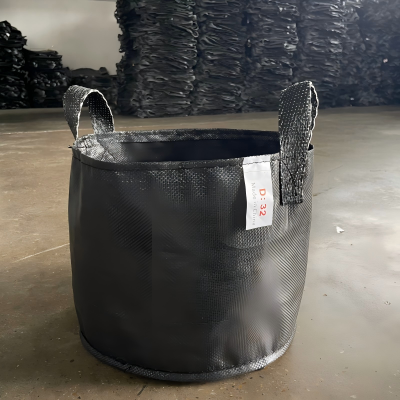
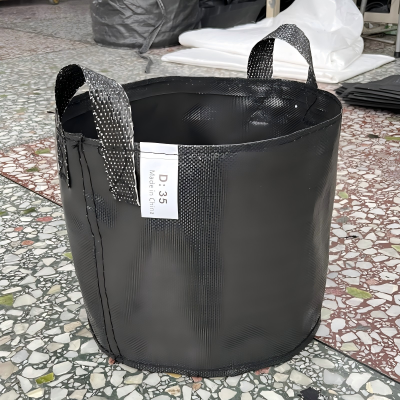
HOKBG produces PP grow bags with UV-resistant properties for outdoor horticultural applications.
Depending on climate and actual conditions, the expected service life is approximately 3–8 years. In tropical regions, it is generally around 3–5 years, while outside tropical regions it can reach approximately 3–8 years.
Actual service life depends on UV intensity, temperature, humidity, handling, storage, and other environmental factors.
7. Strength Matters When Millions of Seedlings Must Be Handled
A small individual seedling may not be heavy, but large-scale nursery operations involve repeated handling.
Seedlings may need to be:
• Moved within the nursery
• Sorted by size
• Loaded onto transport vehicles
• Delivered to restoration sites
• Temporarily stored
• Transferred to planting teams
Therefore, the strength of the bag, stitching, and handles should be considered as part of the nursery logistics system.
HOKBG grow bags feature integrated handles, and the single-side handle has a load-bearing capacity of up to 100 kg.
HOKBG also has a BV test report related to product strength testing and can provide relevant technical information for customers evaluating products before bulk purchasing.
8. Why Nursery Containers Can Improve Large-Scale Operations
When production reaches hundreds of thousands or millions of seedlings, small operational improvements can have a significant effect on total labor requirements.
A standardized nursery container system can help with:
Production organization
Seedlings can be arranged according to species, age, size, or production batch.
Plant movement
Individual plants can be moved without disturbing neighboring seedlings.
Grading
Nursery teams can separate seedlings according to development stage.
Transportation
Plants can be grouped and prepared for delivery to restoration sites.
Nursery space management
Containers can be arranged according to production density and workflow.
For a commercial mangrove nursery, these operational factors can be just as important as the biological characteristics of the container.
9. Grow Bags Are One Part of a Complete Mangrove Nursery System
It is important not to treat grow bags as a standalone solution.
Successful mangrove seedling production also depends on:
• Seed source
• Species selection
• Propagation methods
• Growing media
• Irrigation
• Salinity management
• Nutrient management
• Nursery climate
• Pest and disease monitoring
• Hardening before transplantation
• Transportation
• Site conditions
The grow bag provides the physical root-zone container, but nursery management determines whether the seedlings develop appropriately.
For large projects, the container should therefore be selected together with the entire nursery production process.
10. Choosing the Right Size for Mangrove Seedlings
There is no universal size that fits every mangrove species or every nursery program.
Before selecting mangrove seedling bags, growers should determine:
• How long will seedlings remain in the nursery?
• What is the expected root development?
• What growing medium will be used?
• How will the seedlings be irrigated?
• How far will they be transported?
• What size will the seedlings reach before field planting?
For shorter nursery cycles, a smaller container may be sufficient.
For longer production periods, more root volume may be required.
The objective is to balance:
Root development + nursery duration + substrate use + transportation + handling cost.
11. Dubai's Climate Makes Material Selection Important
Dubai and other parts of the UAE have environmental conditions that can be demanding for nursery materials.
Growers need to consider:
• High solar exposure
• High temperatures
• Outdoor storage
• Dust
• Seasonal humidity changes
• Repeated handling
For a nursery operating under these conditions, selecting a grow bag designed for outdoor use can reduce the risk of premature material deterioration.
UV resistance, fabric strength, and stitching quality should therefore be evaluated before large-scale purchasing.
12. The Broader Opportunity for Mangrove Nursery Infrastructure
The UAE's mangrove target is creating demand across more than just field planting.
A large-scale restoration program potentially requires a complete supply chain involving:
• Seed collection
• Propagation facilities
• Commercial nurseries
• Nursery containers
• Irrigation systems
• Growing media
• Seedling transportation
• Coastal planting equipment
• Monitoring systems
• Restoration services
The UAE has already demonstrated that mangrove restoration involves cooperation between government agencies, private companies, nurseries, and communities. In 2023, a new nursery partnership was specifically established to strengthen mangrove seedling production capacity.
For suppliers of nursery infrastructure, this means that mangrove nursery production itself is becoming an important part of the broader restoration ecosystem.
13. HOKBG Grow Bags for Mangrove Nursery Applications
HOKBG focuses on manufacturing high-strength PP grow bags for professional plant production.
Our grow bags are designed with:
• UV-resistant properties
• High-strength PP fabric
• Good water permeability
• Good air permeability
• Strong load-bearing performance
• Integrated handles
• Long outdoor service life
For mangrove projects, the suitability of a grow bag should always be evaluated according to the specific species, nursery protocol, growing medium, salinity management, production period, and field-transplanting requirements.
HOKBG can provide product specifications and technical materials to help professional nurseries and restoration organizations evaluate the bags before bulk purchasing.
14. What Should Buyers Check Before Ordering Mangrove Grow Bags?
Before placing a large order, buyers can evaluate the following:
Material
Is the PP fabric suitable for the expected outdoor conditions?
UV resistance
Can the bag withstand prolonged exposure to strong sunlight?
Drainage and permeability
Does the fabric provide appropriate water and air permeability for the nursery system?
Strength
Can the bag withstand handling, transportation, and the expected plant weight?
Stitching
Are seams and handles reinforced sufficiently?
Size
Does the container match the seedling's nursery period and root development?
Technical documentation
Can the supplier provide product specifications and relevant testing documentation?
Samples
Can the nursery test the product under its actual production conditions before placing a bulk order?
These checks can help buyers reduce procurement risk when purchasing containers for large-scale nursery operations.
15. Conclusion: Mangrove Restoration Starts Before the Seedling Reaches the Coast
The UAE's goal of planting 100 million mangroves by 2030 represents a large-scale restoration effort that requires more than field planting. The development of reliable seedling production systems is an important part of the process.
Nurseries need to consider propagation, root development, irrigation, growing media, transportation, handling, and field transplantation as one connected system.
For nursery-grown mangrove seedlings, mangrove grow bags can be one useful component of this infrastructure when their material, permeability, strength, size, and durability are matched to the nursery's specific production requirements.
As the UAE continues expanding mangrove restoration, professional nursery infrastructure can help support the transition from individual planting projects to more standardized, scalable seedling production.