Choosing the Right PP Woven Grow Bags for Different Climates and Sunlight Conditions
Choosing the Right PP Woven Grow Bags for Different Climates and Sunlight Conditions
When choosing grow bags, growers often focus on plant type and bag size. However, the local climate is also an important factor.
Latitude, sunlight intensity, UV exposure, temperature, rainfall and humidity can all affect plant growth and the long-term performance of a grow bag. A grow bag used in a high-sunlight region may experience different conditions from one used in a cooler or less sunny climate.
So, what should growers consider when choosing PP woven grow bags for different growing environments?
Why Does Climate Matter When Choosing a Grow Bag?
Different regions receive different levels of sunlight and experience different temperature and rainfall patterns.
Areas closer to the equator generally receive strong sunlight throughout much of the year, while higher-latitude regions tend to experience greater seasonal changes in daylight hours and temperature.
However, latitude alone does not determine growing conditions. Local temperature, humidity, rainfall, altitude and irrigation practices also play important roles.
For this reason, growers should consider the overall growing environment when selecting a grow bag.
How Long Can a PP Woven Grow Bag Last?
The service life of a PP woven grow bag can vary depending on the growing environment. Sunlight intensity and UV exposure are important factors that can affect the long-term performance of the material.
Based on HOKBG's experience, the reference service life of our PP woven grow bags varies by growing region:
- Higher-latitude regions in the Northern Hemisphere: approximately 5–10 years
- Equatorial regions: approximately 3 years
- Higher-latitude regions in the Southern Hemisphere: approximately 5–10 years
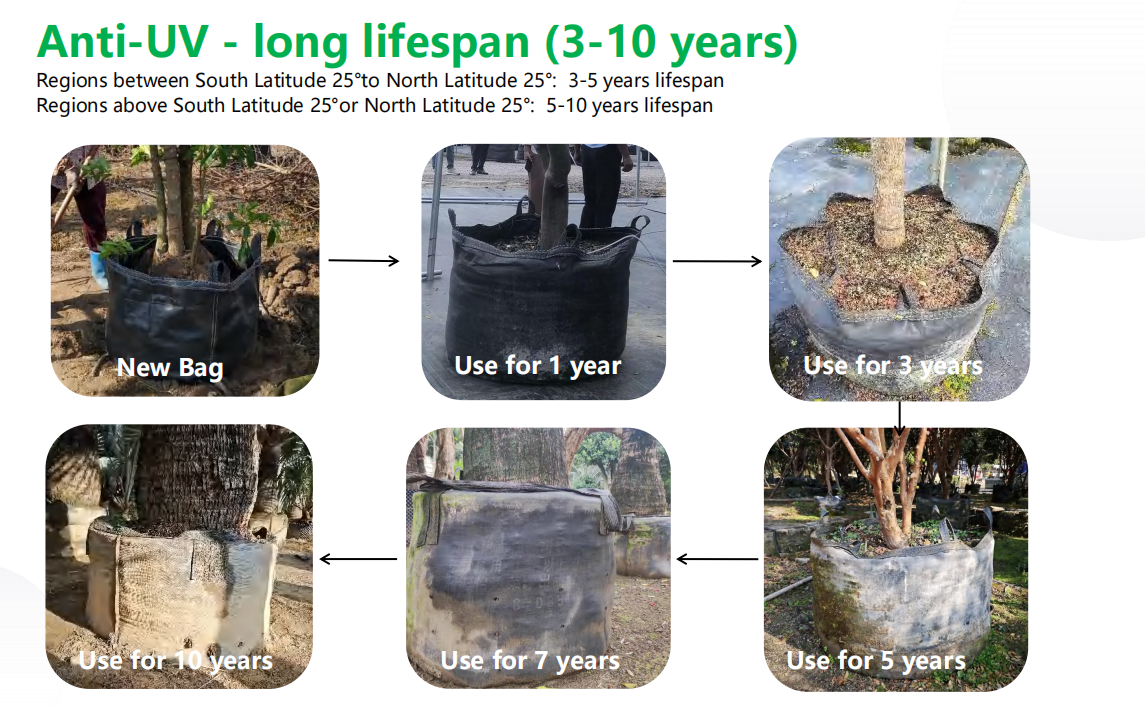
These figures are reference values rather than fixed guarantees. Actual service life may vary depending on sunlight exposure, UV intensity, temperature, humidity, irrigation, handling and other local growing conditions.
This is why climate and local growing conditions should be considered when selecting and using PP woven grow bags.
Grow Bags for Hot and High-Sunlight Climates
In regions such as the Middle East, Australia, Africa and parts of South America, plants may be exposed to strong sunlight and high temperatures for long periods.
Under these conditions, the durability and UV resistance of the grow bag are particularly important.
HOKBG PP woven grow bags are made from high-strength, UV-resistant woven PP material, making them suitable for outdoor nursery and planting applications.
Water management is also important in hot climates. The breathable and water-permeable woven structure allows air and water to move through the bag, helping growers manage the root environment according to their irrigation practices.
How Sunlight and Airflow Affect Root Development
Sunlight is essential for plant growth, but the root environment is equally important.
HOKBG PP woven grow bags feature an open woven structure that allows air to reach the root zone. A breathable growing environment can support healthy root development.
The structure can also contribute to air pruning. When roots reach the sides of the grow bag and are exposed to air, their outward growth can slow down. This can help reduce excessive root circling and encourage a denser, more fibrous root system.
For trees and nursery plants that will eventually be transplanted, good root development can be an important part of producing healthy and well-established plants.
What About Cooler and Higher-Latitude Regions?
In cooler climates and higher-latitude regions, temperature and seasonal changes become more important considerations.
During colder or wetter periods, growers may need to pay more attention to the placement of grow bags, growing media and irrigation.
The water-permeable structure of PP woven grow bags allows excess water to drain away, while the breathable sides help maintain airflow around the root zone.
As with any growing container, good results depend on combining the right grow bag with suitable growing media, irrigation and local growing practices.
What Should Growers Consider Before Choosing?
There is no single grow bag specification that is ideal for every climate.
Before choosing a grow bag, growers should consider:
- Latitude and local climate
- Sunlight intensity and UV exposure
- Temperature
- Rainfall and humidity
- Irrigation method
- Plant species and growth stage
- Expected growing period
- Final planting or transplantation requirements
For example, a tree nursery in a hot and sunny region may place greater emphasis on UV resistance and water management, while growers in cooler and wetter areas may pay more attention to drainage and root-zone conditions.
Why Choose HOKBG PP Woven Grow Bags?
HOKBG PP woven grow bags are designed for a wide range of nursery and planting applications in different growing environments.
Our grow bags feature:
- High-strength, UV-resistant woven PP material
- Breathable and water-permeable structure
- Air-pruning benefits for root development
- Reinforced handles for easier handling
- Long service life for outdoor applications
- Sizes from 20L to 2000L+
- Customized dimensions and printing available
With more than 15 years of manufacturing experience and customers in more than 90 countries worldwide, HOKBG supplies PP woven grow bags for different growing environments and planting applications.
Choose Based on Your Growing Environment
Choosing the right grow bag is not simply about selecting a suitable size. Climate, sunlight, UV exposure, temperature, water management and plant requirements should all be considered.
Understanding your local growing conditions can help you choose a suitable grow bag and manage it more effectively throughout the growing period.
Whether you are growing trees, fruit plants, ornamental plants or nursery stock, HOKBG can provide PP woven grow bags in different sizes and customized specifications to meet your planting requirements.
From different latitudes to different growing conditions, choosing the right grow bag can make a difference to both root development and long-term growing performance.